ADT Hit a New 52-Week High

Provider of security, interactive, and smart home solutions ADT Inc. (ADT) hit a new 52-week high of $9.82 on December 2, 2022. ADT’s stock has gained 15.9% in price year-to-date and 16.9% over the past year to close the last trading session at $9.64.

ADT’s EPS and revenue surpassed the consensus estimates in the last quarter. Its EPS came 52.1% higher than analyst estimates, while its revenue beat the consensus estimate by 0.6%. Higher revenues from the CSB, Commercial, and ADT Solar segments drove revenues higher.

Total CSB revenue increased 7% year-over-year to $1.11 billion in the third quarter, while its total Commercial revenue rose 12% year-over-year to $314 million. Furthermore, ADT’s Solar segment contributed $179 million to its total revenue.

ADT’s President and CEO, Jim DeVries, said, “ADT’s strong third-quarter results demonstrate our continued momentum – setting records in customer retention, RMR balance, and revenue payback. Our performance to date validates our progress on key initiatives, outlined earlier this year during our Investor Day, to meaningfully grow revenue, earnings, and cash flows, as well as reduce debt.”

On September 6, 2022, ADT announced that State Farm would make an equity investment of $1.20 billion in ADT, resulting in State Farm owning approximately 15% of ADT. ADT also announced a new partnership with State Farm to expand opportunities to combine next-generation security, innovative smart home technology, and reimagined risk-mitigation capabilities to monitor, detect, prevent, and minimize homeownership risks.

Post the announcement, the stock had a gap-up opening and has not looked back since.
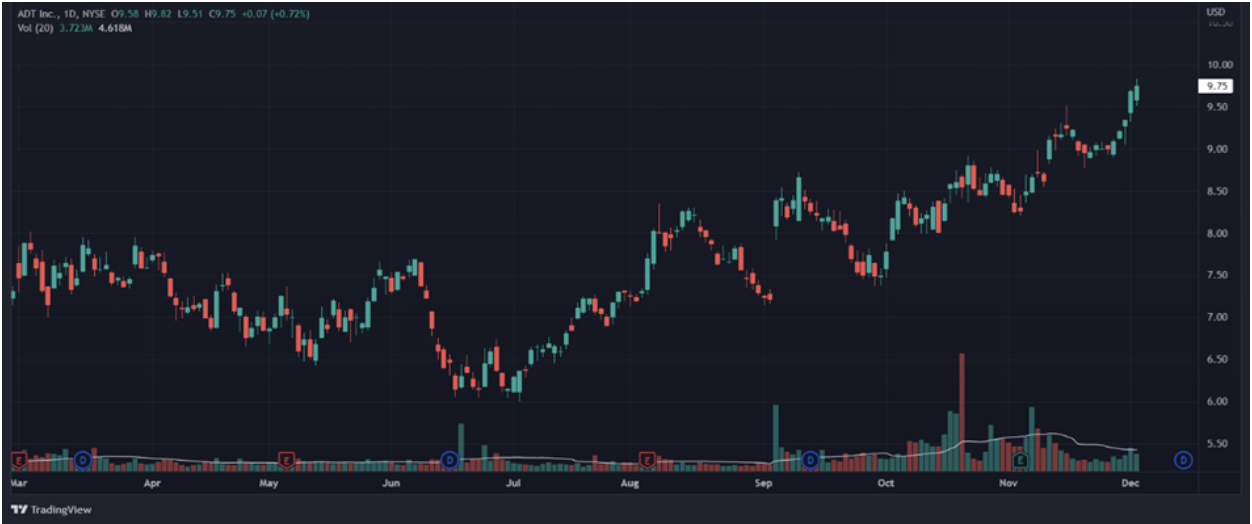
ADT Chart

Source: TradingView

State Farm will also invest up to $300 million in an opportunity fund to support product innovation, technology, and marketing that seeks to differentiate and improve the customer experience for homeowners. Continue reading "ADT Hit a New 52-Week High"

Electric Vehicle Exposure That's Not Tesla

Just a few years ago, it seemed that electric vehicles were never going to "catch on," whether that was because of price, possible reliability issues, or, most importantly, range anxiety. (Range anxiety is the fear that the electric vehicle will not have enough battery to reach its destination or the next charging station, ultimately leaving the driver stranded.)

But, better, much better battery technology, vastly more vehicle and brand options for consumers to pick from, and exponentially more charging stations located all over the country, have changed consumers' minds about the electric car.

While a large number of new, start-up car manufacturers are developing only electric vehicles, one significant change we are seeing is that almost every major car manufacturer is already offering fully electric vehicles or plans to do so in the next few years.

This is nice because we can get our iconic-looking vehicles in electric form; think the Ford F150 pickup truck, the Jeep Grand Cherokee, or even the gas-guzzling Hummer!

Most people don't like change. Thus changing the way a vehicle looks and what powers it may have been some of the reasons consumers didn't rush to get an electric car a few years ago but are now more willing to do so.

Regardless of the reason or reasons why more people are purchasing electric vehicles, the fact is, it appears electric vehicles are not only here to stay but may be the only type of cars on the road in just a few decades. This major shift in how we move from one place to another can also be a massive windfall for your portfolio.

Even though some people may feel they missed the EV investment because they didn't buy Tesla 5 years ago, there are still plenty of opportunities out there that you can put money into today and reap the rewards for decades to come.

Let's take a look at a few Exchange Traded Funds that will expose you to not just car manufacturers in the EV space but also crucial materials and technologies that EVs need to operate.

The first two are ETFs that focus on the production of electric vehicles and the future of transportation. The KraneShares Electric Vehicles and Future Mobility Index ETF (KARS) and the Fidelity Electric Vehicles and Future Transportation ETF (FDRV) invest in essentially the same companies. Continue reading "Electric Vehicle Exposure That's Not Tesla"

2 Gold Miners With Large Safety Margins

It’s been a rollercoaster ride of a year for the Gold Miners Index (GDX), with the ETF starting the year up more than 15% and massively outperforming the major market averages, only to suffer a 48% decline over the next five months.

Since then, the GDX has returned to outperforming, and some of the best names, like i-80 Gold (IAUX), are now up more than 50% from their lows.

This extreme volatility is why it can be difficult to trade the Gold Miners Index successfully. The reason is that one must be ultra-patient when establishing new positions to avoid large drawdowns during the down cycle, but being too complacent at the lows can be costly as the index can turn on a dime when it does bottom.

Fortunately, while several of the best names are already off to the races and out of low-risk buy zones, a couple of stocks are still in the proverbial stable and trading at attractive valuations. In this update, we’ll look at two names that offer large safety margins.

Sandstorm Gold (SAND)

Sandstorm Gold (SAND) is a $ 1.6 billion precious metals royalty/streaming company.

It finances developers and producers in the gold and silver space, giving them capital upfront to build or expand their assets. In exchange, Sandstorm receives either a royalty on the asset over its mine life or a stream on the asset, meaning that Sandstorm has a right to buy a percentage of metal produced at a fixed cost well below the current spot price of gold/silver.

Since royalty/streaming companies typically have royalties/streams on over 20 assets, they are much more diversified than producers with 5-10 mines.

They also have much higher margins, given that they do not have to pay for labor, chemicals, fuel, explosives, and transportation but simply sit back and collect their metal deliveries from these assets.

Finally, the major benefit to owning royalty/streaming companies is that they are not required to spend annually on sustaining capital to maintain an operation, including mine development, drilling, and tailings expansions. In fact, any added resources are very beneficial, given that the royalty/stream is bought and paid for already. Hence, this is a proverbial cherry on top.

Unfortunately, while Sandstorm benefits from this superior model that carries very low risk, the company has had a tough year in 2022. This is because it went out and completed two major acquisitions ($1.1BB value), a smart move, and these deals transformed its portfolio from an average royalty/streamer to one with a phenomenal portfolio. Continue reading "2 Gold Miners With Large Safety Margins"

This Industrial Stock is Well-Positioned for 2023

The world’s largest manufacturer of agricultural equipment, Deere & Company (DE), beat analysts’ EPS and revenue estimates for the fiscal fourth quarter that ended October 30, 2022, despite the uncertain macroeconomic environment, higher raw material prices, and supply chain challenges.

DE’s EPS came 9% above the consensus EPS estimate, while its revenue surpassed the analyst estimates by 6.6%. The company’s Production & Precision Agriculture segment sales rose 59% year-over-year to $7.43 billion. Its operating margins came in at 23.4%, compared to 16.7% in the prior-year period.

Small Agriculture & Turf segment saw similar growth. Net sales rose 26% year-over-year to $3.54 billion, and its operating margin came in at 14.3%, compared to 12.3% in the year-ago period.

Its Construction & Forestry segment’s net sales witnessed a 20% year-over-year increase to $3.37 billion, with its operating profit rising 53% year-over-year to $414 million.

The company’s Financial Services segment’s net income rose 2% year-over-year to $232 million. Despite the challenges, DE’s strong pricing power was on display, as price realization was positive by about 19 percentage points which helped offset a three-point headwind from a higher U.S. dollar.

During a conference call with analysts, DE’s manager of investor communications, Rachel Bach, said, “Across our businesses, performance was driven by continued strong demand, higher production rates, and progress on reducing our inventory in partially completed machines.”

The Moline, Illinois-based company has provided strong guidance for 2023 based on its strong pricing, higher infrastructure spending, and healthy industry outlook. For 2023, its net income expectation is between $8 billion to $8.50 billion, which is 5% higher than consensus estimates.

DE’s Chairman and CEO, John C. May, said, “Deere is looking forward to another strong year in 2023 based on positive farm fundamentals and fleet dynamics as well as an increased investment in infrastructure.”

DE has gained 28.6% in price year-to-date and 26.7% over the past year to close the last trading session at $440.97. Credit Suisse analyst Jamie Cook has reiterated an outperform rating on the stock and has raised the target price from $447 to $582.

Despite the possibility of a recession, do you think DE will be able to meet its guidance in 2023?

View Results

Loading ... Loading ...

Continue reading "This Industrial Stock is Well-Positioned for 2023"

1 Solar Stock to Brighten Your Portfolio

Solar tracking systems and related products manufacturer and supplier Array Technologies, Inc. (ARRY) surpassed the consensus revenue and EPS estimates for the third quarter of fiscal 2022 by 29.8% and 77.4%, respectively.

The company reported revenue of $515 million, compared to $188.70 million in the prior-year period. The revenue growth was driven by the acquisition of STI Norland and strong organic growth within its legacy Array business.

The company’s net income came in at $28 million compared to an adjusted net loss of $11.80 million in the year-ago quarter. Net income per share came in at $0.18 versus an adjusted net loss per share of $0.09 a year ago.

Additionally, ARRY produced $102 million of free cash flow during the quarter, allowing the company to pay down its revolving credit facility fully. At quarter-end, the company had access to $166.6 million of the revolving facility and $62.8 million of cash for total liquidity of $229 million, excluding the additional preferred share availability of $100 million.

“Overall, our performance in the third quarter demonstrates not only the strength of customer demand for our product and service offerings but also the continued effects of our focused efforts to improve our operational execution in all aspects of the business,” said ARRY’s CEO, Kevin Hostetler.

On August 16, 2022, the Inflation Reduction Act was passed by Congress and signed into law by President Joe Biden. It represents a significant investment by the federal government in renewable energy and related technologies. It includes tax incentives that will spur domestic solar manufacturing.

The IRA is expected to allow the U.S. solar market to grow 40% through 2027, equal to 62 gigawatts (GW) of additional solar capacity, according to forecasts in the U.S. Solar Market Insight Q3 2022 report released by the Solar Energy Industries Association (SEIA) and Wood Mackenzie, a Verisk business.

“This report provides an early look at how the Inflation Reduction Act will transform America’s energy economy, and the forecasts show a wave of clean energy and manufacturing investments that will uplift communities nationwide,” said SEIA President and CEO Abigail Ross Hopper.

Do you think the Inflation Reduction Act will impact America's energy economy anytime soon?

View Results

Loading ... Loading ...

Shares of ARRY have gained 23.6% over the past month and 94.9% over the past six months to close the last trading session at $21.61. The stock is currently trading above its 50-day and 200-day moving averages of $17.74 and $13.97, respectively. Continue reading "1 Solar Stock to Brighten Your Portfolio"