The Market Is Looking Expensive

If you are a trader, you don’t care how the market stacks up to past fundamentals.

But, if you are a long-term investor, knowing how the market appears today from a fundamental standpoint, compared to other times, is something you want to keep an eye on.

Knowing when the market is becoming expensive or even overpriced is essential because that tells you it may be time to start taking your foot off the gas. Or the other side of that coin is that the market appears cheap or underpriced.

These times are when the words of Warren Buffett, “Be greedy when others are fearful and fearful when others are greedy,” stand out the most to me.

Buffett is trying to tell investors that when others are buying, despite stocks and the market as a whole being very expensive, you should be concerned. He also says that you should be greedy when others are afraid, likely because of market turmoil and stocks are selling off. Buffett gives you a straightforward, back-of-the-napkin blueprint of when to sell and buy.

With that all said, I don’t believe there are hard-pressed rules on this is when to sell, or this is when to buy.

However, I think now is a time that you should start considering when you will sell or, at the very least, start planning your next moves based on how the market reacts to the coming weeks or months.

One reason I believe we may be hitting a peak is because of general market sentiment. Towards the end of the summer, most market participants, the talking heads on news outlets, and even Wall Street (i.e., the big banks) were saying a recession was very likely in 2023.

However, the market was rallying during that time, then we peaked in August and finally sold off in September. During the fall, the markets were mostly flat, and then things spiked in January. Now the thinking is we may not hit a recession, and inflation may be behind us. Is the market feeling like it could be getting greedy?

But what about the complex data showing us the markets may be overvalued right now? Continue reading "The Market Is Looking Expensive"

Are Bearish Investors Coming Out of Hibernation?

Please enjoy this updated version of weekly commentary from the Reitmeister Total Return newsletter. Steve Reitmeister is the CEO of StockNews.com and Editor of the Reitmeister Total Return.

Click Here to learn more about Reitmeister Total Return


I have been bearish since May 2022. However, I have to admit that the early 2023 evidence did increase the odds of a potential return to a bull market.

That party is over!

Let’s discuss the increasing evidence that bears are ready to come out of hibernation with much more downside to follow. And yes, this will come hand in hand with a trading plan to stay on the right side of action.

Market Commentary

Plain and simple, stocks rallied on a false premise to start 2023.

That being some signs of moderating inflation that could lead the Fed to end their rate hiking regime earlier than expected. This soft landing scenario compelled more investors to believe that bottom was already established and time to bid up stocks for the birth of the next bull market.

The Fed whole heartedly repudiated this idea at the February 1st meeting. They saw inflation as too sticky with no plans to change their hawkish course with higher rates in place through year end.

Bulls were clearly huffing aerosol paint cans at the time because they rallied on the false notion these statements were somehow dovish. The best I can figure out is that because Powell was not pounding the podium and foaming at the mouth that he was somehow dovish.

Clearly not true.

Since then more investors have gotten the memo that the early year rally was premature. Especially after Thursday when the Producer Price Index showed that inflation is much higher than expected.

I saw that event as Strike 3 for bulls as it came on the heels of 2 other events showing inflation being much higher than expected. Continue reading "Are Bearish Investors Coming Out of Hibernation?"

3 Top Auto Stocks For 2023

Last year, the automotive industry’s growth was hampered by macroeconomic challenges, including rising interest rates, material inflation, and continued supply chain issues.

Industry estimates of new vehicles sold in the united states in 2022 range from 13.7 million to 13.9 million, representing a decline of roughly 8% to 9% from the 2021 level and the lowest level since 2011.

However, auto industry executives are cautiously optimistic about a rebound in new vehicle sales in 2023. Toyota Motor Corp (TM) expects U.S. auto sales to grow 9% from the previous year to about 15 million this year. Also, S&P Global Mobility and Edmunds project new vehicle sales to be 14.8 million, while Cox Automotive’s preliminary forecast is around 14.1 million.

Moreover, consumer spending remained strong in the first month of 2023. The Commerce Department reported last Wednesday that retail sales grew by 3% in January, exceeding the estimate of a 1.9% increase. A significant jump in auto sales primarily drove the gain in retail sales.

Furthermore, sustained demand for electric vehicles (EVs) should boost the auto industry’s growth. U.S. EV sales leaped by two-thirds over the past year. According to year-end figures released by market research firm Motor Intelligence, automakers sold approximately 807,180 fully electric vehicles (EVs) in the United States in 2022, up 3.2% year-over-year.

What do you expect the electric vehicles market share in the United States to be by 2030?

View Results

Loading ... Loading ...

Based on a report by Contrive Datum Insights Pvt Ltd, the global electric vehicle market is projected to reach over $1.10 trillion by 2030, growing at a CAGR of 23.1%.

Given the promising prospects, it could be wise to take advantage of the uptrend in auto stocks General Motors Company (GM), Stellantis N.V. (STLA), and Honda Motor Co., Ltd. (HMC) for outsized returns this year. Continue reading "3 Top Auto Stocks For 2023"

Platinum Outshines Palladium, Yet Both Offer Opportunity

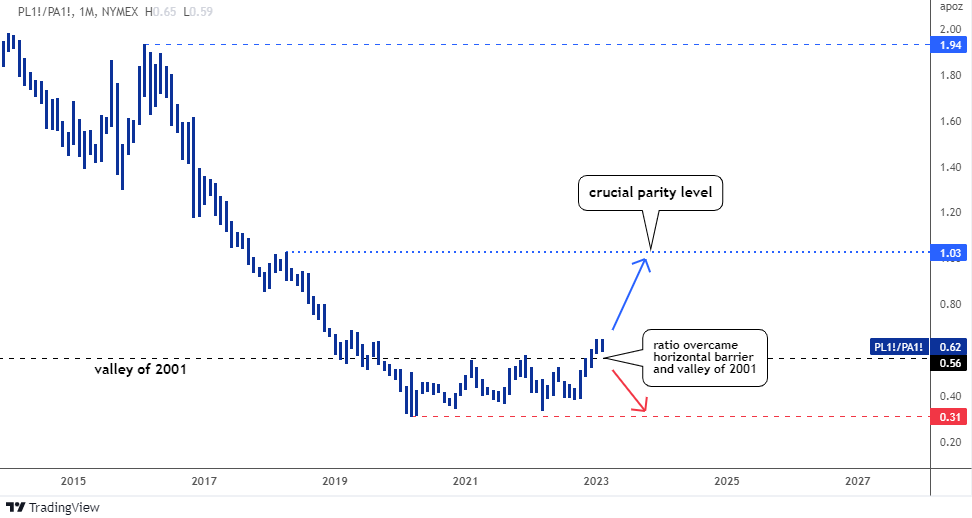
Almost four years ago, I wrote about the supremacy of palladium over platinum, and we watched the Platinum/Palladium ratio fall below its long-term valley of 0.56 oz.

In contrast, today the Platinum/Palladium ratio is approaching a 4-year high of 0.7 oz, marking a doubling from its all-time low of 0.31 oz established in 2020.

Platinum-Palladium Ratio Monthly

Source: TradingView

On its way up, the ratio broke through a double barrier that included the 2001 valley of 0.56 oz and the horizontal resistance at the top of the range. There are no other barriers for the ratio until it reaches parity between the two metals, which will be a crucial resistance level.

This is because palladium was replaced with the cheaper platinum in the automobile industry due to palladium's abnormally expensive price.

It is estimated that the platinum substitution of palladium reached 340 koz in 2022, and it is predicted to increase to over 500 koz in 2023, more than twice the amount in 2021. Continue reading "Platinum Outshines Palladium, Yet Both Offer Opportunity"

2 Small-Cap Names With World Class Deposits

While the Gold Miners Index (GDX) started the year sharply in positive territory and raced ahead of the S&P-500 (SPY) despite its rebound to start 2023, the index has retreated all the way into negative territory as of mid-February, giving up considerable gains.

This has led to considerable underperformance vs. the S&P-500 (SPY), and this isn’t overly surprising given that sentiment was becoming overheated short-term in the miners heading into late January.

However, with the index down more than 15% from its highs, it’s time to start building watchlists for potential buying opportunities.

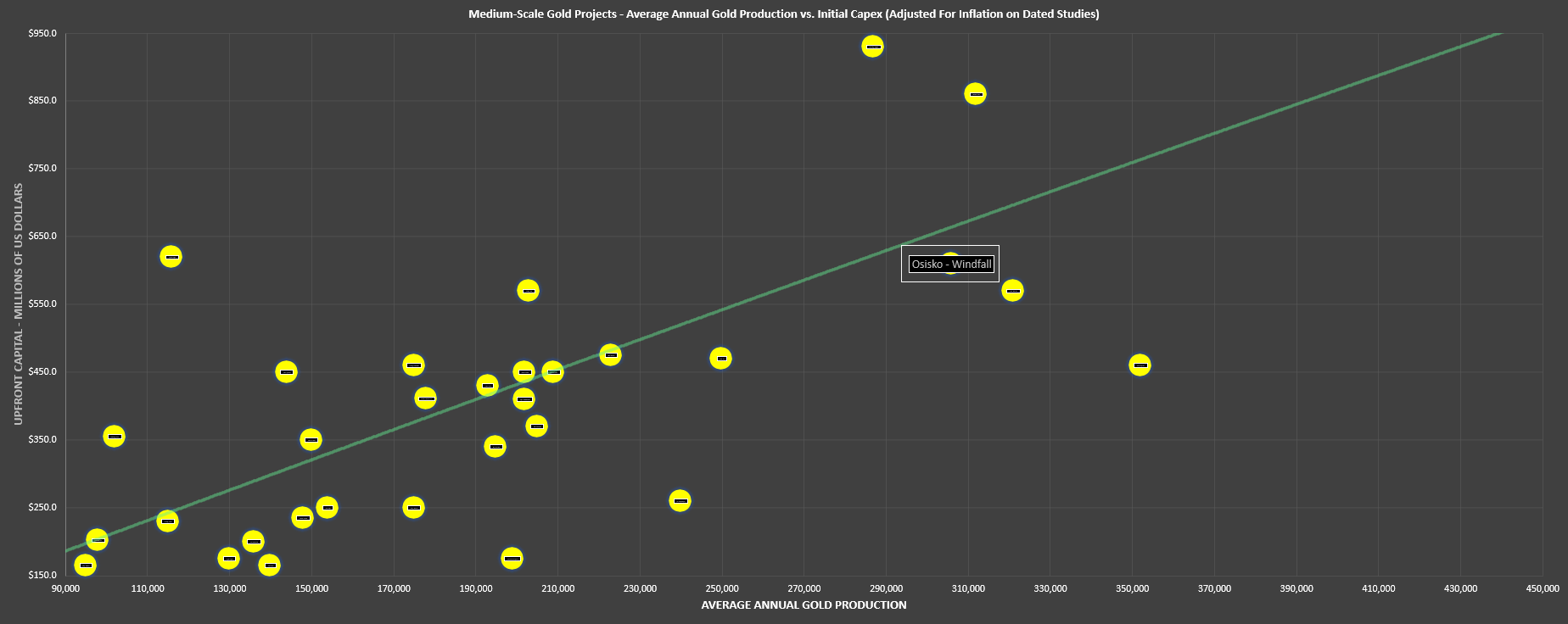
In this update, we’ll look at two small-cap names with world-class deposits aiming to become 250,000 ounce per annum producers post-2025.

Osisko Mining (OBNNF)

Osisko Mining (OBNNF) is a ~$1.0 billion gold developer based on an estimated ~465 million fully diluted shares, and it’s well known for being the proud owner of one of the highest-grade gold projects globally in Northern Quebec, Canada.

This project, known as Windfall, hosts more than 7.0 million ounces of gold at an average grade of 12.0+ grams per tonne gold, and would be one of North America’s highest-grade mines if it were in production today.

Once in production (2026 estimate), the mine is expected to produce upwards of 270,000 ounces of gold per annum at sub $725/oz all-in-sustaining costs, translating to ~61% margins at an $1,875/oz gold price assumption.

Windfall

(Source: Company Filings, Author’s Chart)
Continue reading "2 Small-Cap Names With World Class Deposits"